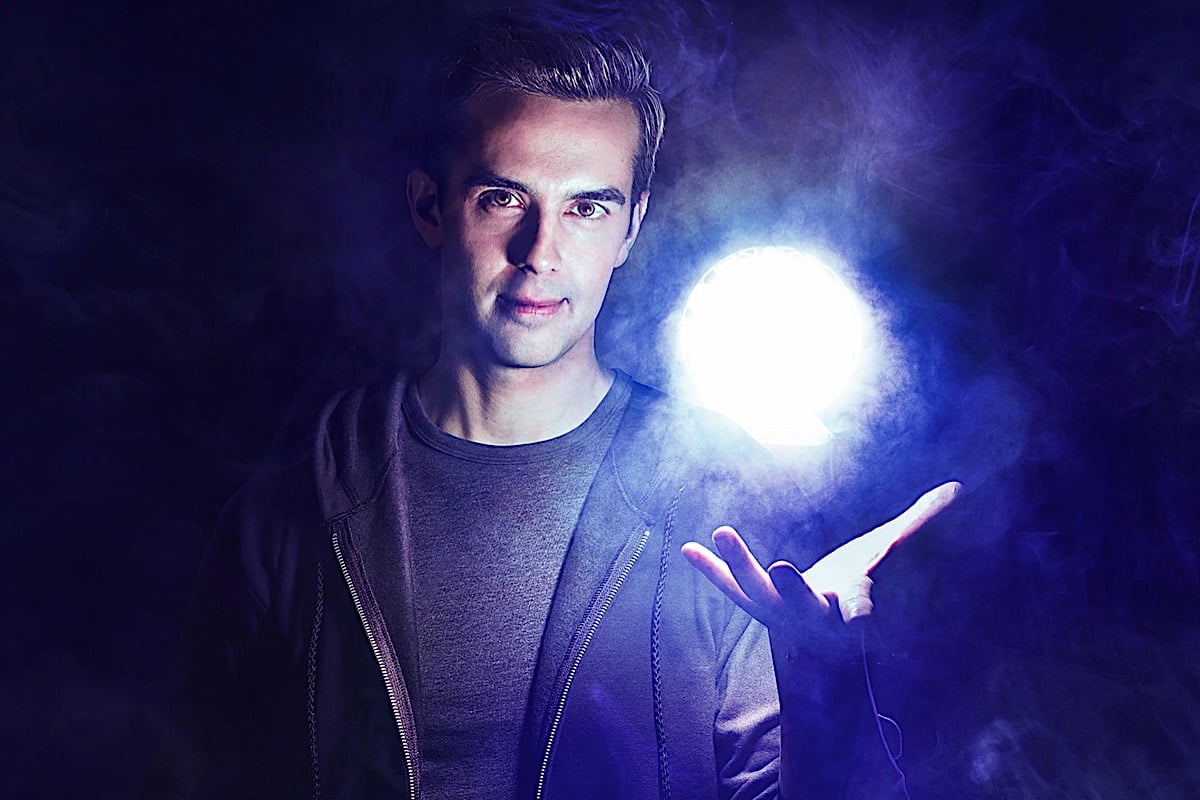
For more than a decade, Michael Carbonaro has made a career out of convincing people that the impossible might actually be possible. Best known as the star and executive producer of truTV’s The Carbonaro Effect, Michael has spent more than 100 episodes turning everyday situations into elaborate exercises in illusion, comedy and sheer disbelief. But long before unsuspecting shoppers, baristas and museum visitors were asking themselves, “Wait, how did he do that?”, Michael was a kid on Long Island discovering the magic of illusion.
That childhood sense of wonder is at the heart of Wonderboy, Michael’s latest and third national live tour. Kicking off on September 19 with shows across the country – including a stop at Georgia’s Sandy Springs Performing Arts Center on October 10 – the tour’s name comes from a newspaper article that once billed the teenage magician as the “Boy Wonder of Magic and Illusion”, a title he absolutely hated at the time. Now, decades later, he has come to appreciate the sentiment behind it. For him, Wonderboy is about reconnecting with the imagination we have as children and often lose as adults.
In our conversation, Michael talks about the inspirations that shaped his approach to magic, from Doug Henning and David Copperfield to Penn & Teller; why mystery remains so important in a world where we can find almost any answer with a phone; and the special live moment he’s bringing back for the finale of Wonderboy. He also opens up about growing up gay, the outsider perspective that shaped him as an artist, his marriage to actor/producer Peter Stickles and why he still gets nervous before walking onstage.
Let’s talk about the new tour, Wonderboy. What can audiences expect from this show that they might not have seen from you before?
Ooh, yeah. A lot of people haven’t seen me live on stage. They know me from the TV show. Obviously, on the TV show I’m fooling people who don’t know that I’m a magician and, on this tour, you’re coming in knowing that and then the game in a live show is to see if I can still fool you and have that same kind of fun – and you hopefully find the answer is yes.
Wonderboy is my third live national tour and this one actually came from an old article I found when I was a kid and performing in Long Island, and they had billed me in the newspaper as the “Boy Wonder of Magic and Illusion”. I was, like, 14 years old at the time and I was appalled. I was devastated. I was like, “That is the cheesiest name. Oh my God.” I wanted to be taken seriously. I wanted to be like David Copperfield. I wanted to be legit, and it’s funny because now I look at that and I’m at a point in my life now where I’m like, “Man, I was the boy wonder of magic and illusion. That’s pretty cool.” So, this is like a touchstone back to that time. Imagination is a superpower when you’re a kid, and then we grow up and as an adult sometimes we kind of lose touch with that. So, this is about really touching back to that fun, magical energy of being a kid.
You mentioned David Copperfield, but who were your other inspirations? Who got you interested in magic?
Doug Henning was probably the first one I saw on TV when I was really little. I saw, I think it was Ann Jillian, got compressed in this illusion. She got flattened down to a little disc, like a record, and I really felt…like I knew he was a magician, but I didn’t know that meant it was a trick. I just thought he actually did this, and it was actually like frightening. I’ll never forget the impact of seeing that happen, and I ended up on The Carbonaro Effect TV show, I did a riff on that trick at a pet shop where I compressed pets into these flat little records for travel and then uncompressed them.
But yeah, so Henning and then Copperfield. I watched his specials every year and I think I learned how to be a host from watching him. I loved the way he could break in and out of being totally goofy, and then being really serious and dramatic and playful, and then he won Emmys from those specials. The dance and the lighting and the set design, they were just so beautiful and that was a real inspiration for me.
Penn and Teller kind of popped the balloon of that seriousness of magic, which I thought was really cool. It was, like, another angle. So, with your Copperfield and your Penn and Teller, I got two different, really great schools of thought. Oh, magic can be two totally different kinds of ways to play and I think that’s how I got inspired.
You’ve been performing magic for many years. How do you keep creating new illusions and finding new ways to surprise your audiences?
Yeah, that’s the tough one. If I think too hard about it, it doesn’t seem possible. I usually step into everything like, “Oh my gosh.” I have an abundance issue, I guess, where I’m like, “Oh no, it’s going to run out” – like I’m going to run out of magic. And especially when I was doing the TV show, it was like how are we possibly going to do this? And the truth is, it just keeps coming. Imagination really is endless, and I don’t always believe that, and that’s kind of back to Wonderboy again.
When you’re a kid, you don’t ever feel like your imagination runs out. It’s like it doesn’t, and so I allow anything to be an inspiration, and it could be just something that I see. I might see, I don’t know, a bag of marshmallows that says jumbo-sized marshmallows, and I’ll be like, “Oh, jumbo-sized marshmallows. What if it was like the biggest marshmallow in the whole world? What if a small marshmallow could become jumbo and then it could become small again”? and I’ll just riff on what it could be and grow it from there.
Your magic has always been as much about comedy, storytelling and character as it is about the illusion itself. How do you decide when a trick needs to be spectacular versus when the funniest thing is simply the reaction to it?
That’s a great question. I think when I was first learning magic, I was really focused on seeing if I can get somebody to be fooled by this and really believe it’s happening. And now I’m more interested in what that does to someone when they believe in magic because it’s an astonishing thing how magic, I think, is the only art form that it really reminds you that the world doesn’t work the way that you think it works – and that is a really exciting feeling. That’s why people drop their jaws and inhale quickly because it’s a refreshing thought that we think we know everything in this world and we can look up anything on our phones and find the answers and things, but mystery is so important. I think a moment of magic when you see something levitating, you’re like, “Wait a minute, that, that’s not how… Wait, there’s secret little, trap doors in the universe I didn’t know about,” and that really excites people, and I think that’s what’s really important about it.
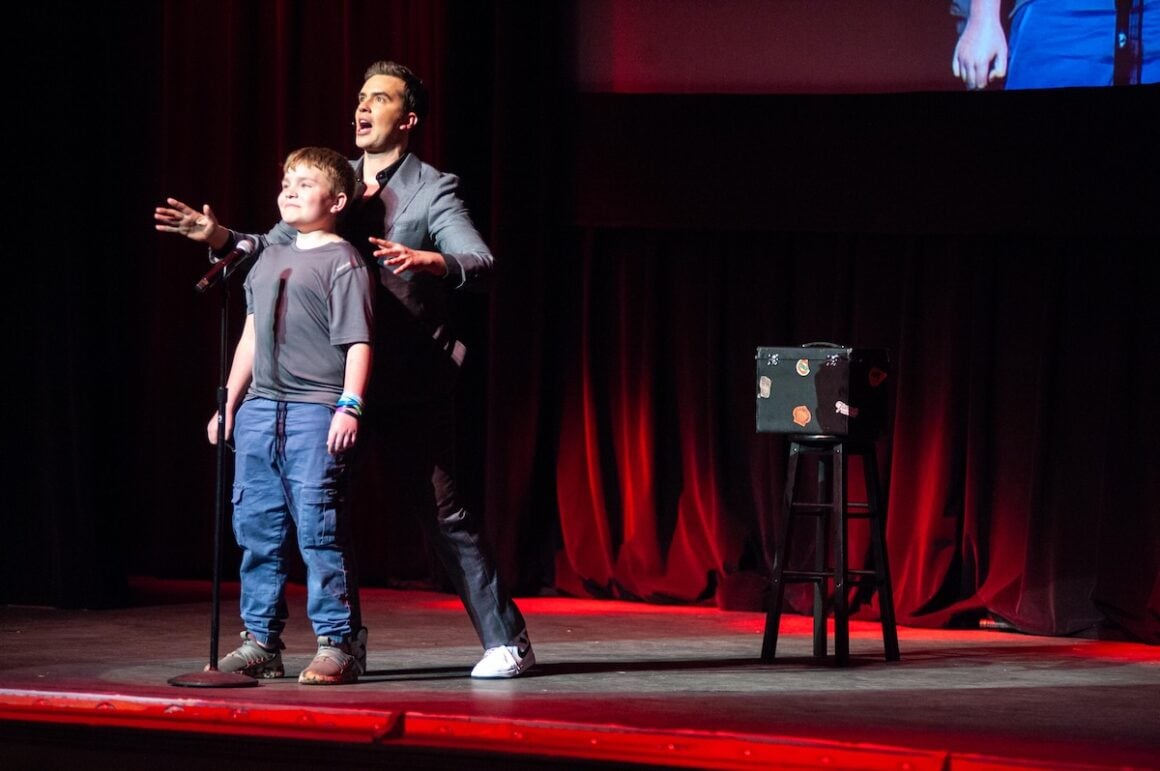
So, at heart, there has to be that, and I think every presentation has a bit of that. Sometimes, like in the tour, I have tricks that are just fun and playful, and I’ll bring a kid up on stage, and the trick’s cool and you won’t know how it works, but it’s more about the fun we had. And then there’s other times in the show where I’ll do something where I really want people to be like, “Wait a minute, how is that happening? That is a real deep mystery.” I kind of like to play around with all of those different levels.
Is there a trick or a moment in Wonderboy that you’re particularly excited for audiences to experience?
Yes. I’m closing the show with a famous act of mine. I have done it before, but I haven’t done it on stage in years. It’s this act that is very magical without any trick. It’s like a performance art piece, and it’s called The Shaving Dream. It harks back to something I used to do when I was a kid. It’s hard to explain, which is exciting. But it’s a visual clown act, a silent act. It’s to music. Essentially, it’s a little vignette.
I’m in front of the mirror, which is the audience, and I’m in a towel like I just got out of the bath, and I cover myself with shaving cream, and I sculpt myself into all of these different creatures and monsters and just morph from one thing to the other just using the cream like a sculptor. And it’s really magical, and it really touches back to my first love. My first way into magic was special effects. I love monsters and horror movies and special effects and it’s this real left turn at the end of the show that kind of leaves people in a true sense of awe in a way that no one has to go, “How did that happen?” Because they see it happen, but it’s the magical thing that happens when you see a really good, let’s say, puppeteer, where, like, all of a sudden the puppet looks like it’s alive and you can see the strings. You know what’s going on but you feel this magical connection to it. So, I kind of try to evoke that sort of a magical feeling to leave people with at the end of the show.
What is it about live theater that continues to draw you back after years of television and hidden-camera work?
I’m very grateful to have had a TV show, and I’ve had 125 episodes. I can’t believe we did that many. Talk about abundance. I just can’t believe it. But it’s a real different thing. It’s a very difficult thing, and there’s less fun in making the TV show than there is when I’m performing on stage. There’s so much fun in pulling the stuff off and sharing major high-fives with the crew when we get somebody to believe in something and getting to watch it with my friends or family or hear about it when the episode is finished and it’s actually on air. There’s joy in that. But the process is a totally different animal. It’s a grueling, difficult, stressful, high-pressure type of way to perform that I don’t love as much as I love being on stage. It’s like I get to be free, and we’re here in the moment together, and there’s an electricity to live performance that will just never be beat by television.
You’ve had the opportunity to perform with Penn & Teller. What have you learned from them about the craft and business of magic?
They don’t take anything too seriously. I remember one time I was asking Teller, who does talk off stage, a question that people ask me too, and I love giving his answer. I asked him, “Do you like to call it an illusion or is it like a piece or a vignette or an art?” He replied, “It’s a trick. Just a trick.” He’s like, “It’s my needle trick.” We were happening to be talking about the needle swallowing trick. And I love that. It just takes the just takes the piss out of it, if I can use that expression. Just very down to earth. Yeah, it’s just a trick. Sometimes, when my husband comes out on the road with me – and he’s in the show too, and he helps out, and we have our toy poodle, who is in the show as well – and sometimes we’re getting all stressed out, like, “Oh, we’ve got to get this ready and everything, and who’s in the audience? And we’ve got to be…” And then we’re like, “Wait a minute. It’s just a magic show.” and it’s good to bring that back down to earth.
You’ve performed in Las Vegas and now Shin Lim’s there, Piff’s there, all these talents are there. What is it about Vegas that makes it such a special place for a magician?
Isn’t that something? It somehow just became this magic wonderland. Henning was there early and not in like a residential situation, but we had Siegfried and Roy. When they had their show, it somehow just became this incredible mecca. There’s an escapism to Las Vegas; there’s this sensational aspect and escape into non-reality that magic just slips right into really well. So, it just became a thing and now I can’t believe how many magicians are in Las Vegas.
I don’t love Las Vegas. I don’t want to live there or perform there but I loved when I got to take over the Penn and Teller Theater, it was so great to be in one place and do the show and have a little residency there and everything. But yeah, it’s always tied to magic in a way that I can’t believe is still going.
You’ve talked in the past about growing up gay and how that affected the way you saw the world and your role as an artist. How did that experience influence the kind of performer you ultimately became?
There’s sort of a loner aspect of being an artist, which I think sort of ties into the same kind of thing. An artist sometimes feels like an outsider from society and growing up when I wasn’t out of the closet, in the late ’80s and early ’90s, where I knew I was gay but wasn’t telling anybody, there’s sort of this loner, outsider feeling as well. And there’s a tie-in with the secret keeping, too, because as magicians, you keep a secret, and you have a secret. So, there’s that, which is beautiful and hard too.
I still think, as much as the world has changed in a way, at least where I get to live and be and who I surround myself with, where it’s so much more accepting and while free to be who I am I’m still marked by those feelings of repression and feeling like a loner and an outsider, and I have to keep myself in check with that.
I was just talking to my husband about this too. We were talking about Ricky Martin, who is an actor in all these TV shows now and he’s so fantastic. I saw him on stage. He blew us away. That guy just leaves his soul on the stage. He knocked it out of the park. But I was like, “Do you remember when Ricky Martin was just becoming popular and we were hearing in the gay circles that people were saying he was gay?” He could not come out. Of course he could. Everyone can make their own choices. But the world was so different, and that was a major thing, where now he’s out and I’m like, gosh, you forget, and it’s an incredible thing where we’ve come.
But to grow up in that environment, I think that as an artist, I think it shapes a kind of appreciation for me about getting to live through that. I really am excited about the generation that I grew up in. I love that I went to high school and college. The internet was just coming out when I was in college, but we didn’t use the internet for like our papers. There was like a computer lab or something you would go to. But we certainly didn’t have it in our pocket and I really love that I got to be there for that because we live in a place now where anyone born after that, you will never know what that was like. I feel like it was a really cool generation to grow up in and I think if it makes anything happen, it’s an appreciation and a gratitude for knowing how it was. I feel lucky to have grown up in that generation and the change technologically that the world went through, and also the same thing with getting to be out or not out where it’s not so much of a big deal anymore.
I’m very familiar with your husband, Peter Stickles. Since he’s a creative person as well, what is it like being married to someone who understands the demands and strange hours of a performance career firsthand?
Oh, man. Again, gratitude and grateful. I can’t believe it works so well. We just have this wonderful understanding and freedom with each other, it just clicks. We have our own worlds. We have our friends that we have together. We have our friends that we have outside of each other. But it’s so cool to be able to have that kind of that freedom and it’s great to have a fellow creative person and an artist who just sort of gets it and the same struggles too.
After everything you’ve accomplished, is there anything that still makes you nervous before you walk out on stage?
Yes, and I feel really grateful to still be nervous because, we talk about this too. It would be a little scary to not be a little nervous because it’s like I care, and I want it to go well, and the nerves are wanting to be in line with making things work and make it good and be present and do a good job.
Some shows I’m just like, “Wow, I’m feeling really confident. I’m just going to go out there and go.” And other shows I’m like, “Whoa. I’m strangely nervous today.” I remember I did a show in New York City once when Stephen Sondheim was in the audience. David Blaine was in the audience. Ben Stiller was in the audience, and I was cool as a cucumber and had this incredible show, and I remember being like, “Whoa, that’s so weird.” Then the next day I was like out in Long Island performing, and it was my hometown, and I’m backstage biting my nails, I was just nervous. And I’m like, who knows?
What would you like the next chapter of your career to look like?
I would love to get to be in more film and television stuff, and I’ll never stop performing live because I always love doing that. I do have a couple of magic TV things going on. One’s looking really good, so cross your fingers.
When someone walks out of Wonderboy, what do you hope that they feel that they didn’t feel when they walked into the theater?
I hope they feel elated just from being submerged in the show. I think ultimately what comes out is a kind of joy in the comedy, the magic, the entertainment and the excitement together is a sense of joy. Hopefully, maybe reality betrayed them a little bit and maybe they’re arguing with each other in the car ride home about how the tricks worked. But ultimately, it’s all about being together and having an awesome time and thinking that there are mysteries in the world – and that’s an exciting thing.
Michael Answers the Socialite Seven
What’s the one magic trick you wish you could perform in everyday life?
Oh. I would like to be able to fly in everyday life.
What’s the weirdest thing you’ve ever been asked to make disappear?
Now you’re… Okay. We’re going into that naughty section again. Let’s see..weirdest thing I’ve ever… Everyone always asks if I can make their spouse disappear.
Las Vegas or New York?
New York.
If you could fool one celebrity with a magic trick, who would you want it to be?
Ooh. Steven Spielberg.
What is your go-to karaoke song?
Secret Agent Man.
If you could have dinner with any magician from history, who would you choose, and what would you ask them?
Probably David Devant and I would ask him to tell me how he retained his own sense of wonder throughout his entire life.
What is the best piece of advice you’ve been given?
Really to do what it is that you truly love. Stay in touch with that.
Michael Carbonaro’s Wonderboy Tour kicks off on September 19, with dates through March of 2027. Get your tickets and more info on Michael’s website. Follow Michael on Instagram, Facebook and TikTok.