
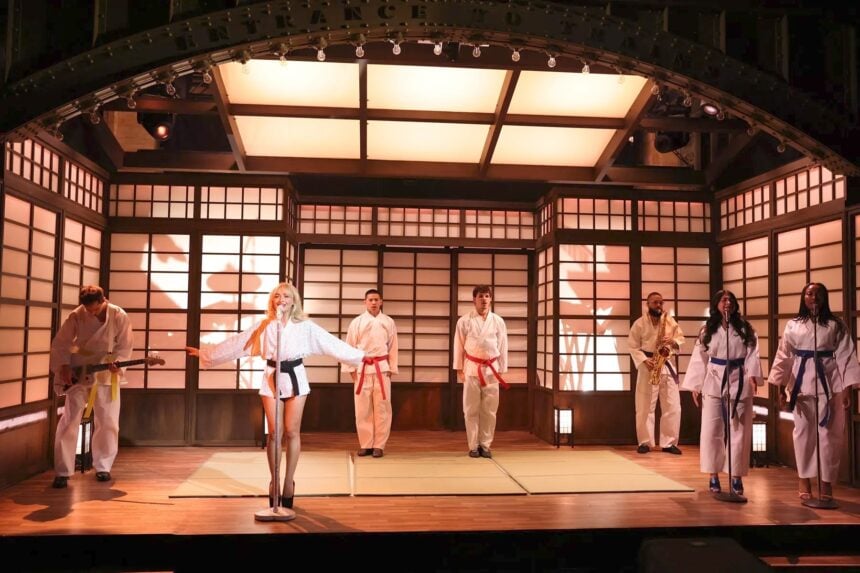
Pop star Sabrina Carpenter is facing backlash following her recent Saturday Night Live appearance, with fellow artist Rina Sawayama pointing out cultural missteps in the performance of “Nobody’s Son.”
Carpenter appeared on the October 18 episode of SNL as both host and musical guest, performing tracks from her latest album, Man’s Best Friend. During her rendition of “Nobody’s Son,” the 26-year-old singer staged an elaborate martial arts-themed production, complete with a dojo setting and background dancers dressed in traditional karate uniforms known as gi.
The performance quickly drew attention, though not entirely for reasons the creative team may have anticipated. Japanese-British singer Rina Sawayama addressed the issue directly on Instagram Stories, sharing a clip from the performance and highlighting a significant cultural oversight. The production featured traditional Japanese tatami mats on the studio floor, yet dancers wore sneakers while performing choreographed fight sequences on these sacred surfaces.

Sawayama wrote in her post: “Big love to Sabrina but fellow artists creative teams … if we are clearly referencing a culture, please can you do so with the research, respect and care it deserves.” She emphasized the severity of the oversight by noting that wearing shoes on tatami mats is considered deeply disrespectful in Japanese culture.
The criticism centers on a fundamental aspect of Japanese cultural etiquette. Tatami mats are traditional woven floor coverings used in Japanese homes and martial arts studios. According to Japanese custom, people should never wear outdoor shoes or even indoor slippers on these materials, as doing so is considered a serious breach of respect.
While Carpenter herself wore platform heels and only briefly stood on the mats during the performance, critics have noted that the overall aesthetic appeared disconnected from the song’s themes. The martial arts setting seemed to lack meaningful connection to the heartbreak ballad’s content.


The controversy raises broader questions about cultural representation in mainstream entertainment. Some observers have suggested that the production team’s oversight indicates a lack of diversity behind the scenes, noting that consulting with Japanese cultural experts during the creative process could have prevented the misstep.
At the time of publication, representatives for SNL and Sabrina Carpenter have not responded to requests for comment regarding the cultural sensitivity concerns.
MORE POP CULTURE HEADLINES